architecture design studio I
Project 1: Self-expression through Object 'REPRESENTING ME'
The Ice breaking design project introduces basic understanding of the design processes and approaches in generating ideas, formulating conceptual narratives, developing design and translating it into form design.
The purpose of the project is for students to unravel their creative side and inner self through several specific modes of communication or art form. Student as designers will generate ideas from self-identity through personal interests, preferences, attitude and personality. These ideas and qualities will later on is applied to an artwork worn on specific parts of the body, mostly parts of the body that is use for creativity and making. Artwork is to be worn on head (thinking), hand (making) and face (showing & expressing). Student will either create a mask, a helmet or a hand glove to show self. Representation of self must only be interpreted in abstracted form where in it requires rigorous design thinking and highest form of creative interpretation. Understanding , using and applying basic elements of design such as meaning of lines, shapes, textures and colours are key in expressing self in a more abstracted, creative and expressive way.
The final outcome of the project is open to any possibilities, meaning you are free to explore form, materials (prescribed) and techniques as long as it shows the creative and personal identity and is well explained in the written essay.
Emphasis is to bring out the creativity and initial character or personality as a new designer.
“'You are what you are seen to be' - Erik Spiekermann


Project 1's Self Expression Assignment has definitely widen my knowledge in the art of abstract co-relating with architecture and how it becomes an apparel to the human body. I have learnt how to express myself through art and architecture, in which how the form, space and order of the model reflects my personality.
In my model, I have chosen to express myself best in my flexibility. My flexibility stands in mentally and physically in my self. I categorise myself flexible in how I easily fit in the surroundings; or how there is a sudden change in the environment. I always adjust myself to the surroundings as I find comfort as being a part of the society and the surrounding environment. I find most ease when I get in touch; or rather being exposed to the differential of the adjacent spaces around me.
In relating to my personality, the design of my model is created in such a way where the different size of form conforms to each other within the space generated. Hence, when the sections of my model conform each other, there is a 'lock' sensation initiated within the model. This thoroughly explains that when my model is crumpled, there is a lack of spatial flow created within the space, hence there is no continuous flow of space within the model. Co-relating to my perspective of flexibility, when I do not have sufficient space for myself, there will be a lack of flow in the continuity of generation of thoughts within myself. Consequently, I will be 'suffocated'; when my model is to be worn on myself as when it is crumpled. A rather tight, locked & suffocating sensation will be felt. However, as I am flexible enough to adapt to the surrounding as well, when the model is stretched, it creates ease for the continuity of the flow of space within the space generatied within the model. Thus, when worn on myself, the flow of thoughts in me will have a continuity as well; as I obtain sufficient space within myself; as well as the adjacent spaces around me.
Project 2: Self-expression through Architectural Space 'Furnitecture'
The main aim of Project 2 is to expand the interpretation of the self (or multiple self) by exploring the relationships between human body and designed form. The student or students as the user or users will define the intention of the space and its form based on their personality and human body.
In this project students will also be introduced to basic design principles such as rudimentary ways in which to order and organize spaces and forms. Furthermore develop an understanding of scale and proportion with relation to the human body.
Project 2 will be divided into 2 stages; first we shall explore the notions of scale and proportion. This is done through a series of exploratory in-class exercises where we explore human form (anthropometry). We will then progress on to understanding how the human body relates to space, and further developing an understanding of scale and proportion in relationship with body and space.
The 2 stages mentioned will be presented by groups in the intention to enhance the ability to articulate space and form from interpretations of the self. This development will be through a series tests and investigations involving scaled models ‘study models’. The Final Design will then be produced as a full 1:1 scaled cardboard assembly and installation.
Student will specifically translate their personality and design intentions thru designing ‘Furnitecture’, furniture that transforms to architecture using cardboard and cardboard fittings and assemblies. Cardboard furnitecture must be highly functional and usable.


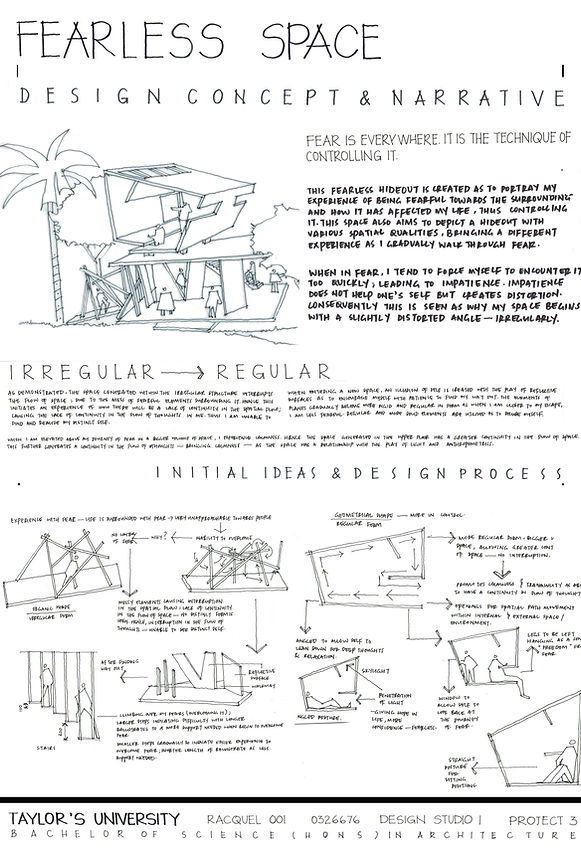
Project 3: Dreamspace for the user 'SPACE FOR THE SELF'
In project 1, students were allowed to express oneself through their creative means; Project 2 is meant to prepare students to be aware on the relationship between user and space, emphasizing on the physical and non-physical requirements; Project 3 on the other hand incorporates both the creativity and its functionality; identity of user, comfortability of user and creativity in articulating the space, as a complete user experience.
For the final project, students are required to design a space for the self by attaching it to the walls/surfaces of an imagined ‘city’ in an empty abandoned lot in between two buildings. The space is to fit a specific use (as a dream space: for viewing, space for contemplating, space for self- exploration, space for exercising, space for dreaming, space showcasing and so to speak a dream space for the user). As the user of the space you can make your personality more interesting, an effective well thought of theme and written narrative is essential.
This understanding is to be architecturally translated into a series of connected spaces (2-3 spaces) that successfully establishes the quality and articulation of the interior and of exterior design. Concept shall evidently show the experiential and spatial quality. Students are also to consider how well design conforms to both the physical and non-physical requirements of the user.
Final project will be in 3 stages, Task 1- is narrative writing wherein it can be based in the persona, life scenario, story and journey of the user from where or which the theme of the hideout will be extracted. Task 2- is about exploring how to organize the 2-3 spaces which encompasses design principles in spatial relationships and organization. In this task students will explore ways on how to explore space through hierarchal arranging it by its meaning, significance and importance, capturing mere essence of the narrative. Task 3-In addition to generating and exploring ideas and concept from the narrative and spatial exploration, we will also explore the notions and experiential effects of materials and the senses in the final design.