design communication

Project 1: On-site sketching & tonal values
A first-hand conscious experience is important in the understanding and articulation of space. This assessment introduced students to visualization and expression of space through on-site sketching activity on campus. Students are required to develop their skills in creating depth and tone in a sketch, and thus refining and enhancing the ability to produce an architectural sketch that is legible.
The objectives of this project are as follows:
-
To understand the notion of space in architecture.
-
To develop skills in visualizing of space through observation and perception of a given site
-
To develop skills in sketching as a mode of communication.
-
To understand the notion detailing’s in architecture and objects.
-
To develop skills in communicating the above in various tonal and depth values.
-
To develop various techniques of hatching through different medium.
Requirements to capture/emphasize the aspects of built environment within the site as for the understanding of space:
-
Solids and voids: Form, Skin, Structure
-
Opening/Aperture; openness/enclosure; inside/outside; light/shadow
-
Rhythm in architecture
-
Details
-
Textural effects/Materials
-
Landscape/Setting
-
Scale and proportion (Relation to human and other surrounding built environment)

Project 2A: Part 1: Orthographic projections (Plans, Elevations, Sections)
Orthographic projections:
“A means of representing a three-dimensional object in two dimensions along with drawing that communicates the shape and size of an object through a series of related two-dimensional views” - Edwin Chomen
To utilize the given images of a furniture (in this study, a table) to be drawn up.
-
Demonstrate drafting skills in modern and traditional methods of architectural drawing.
-
Record and present clear and legible architectural information manually.
-
Identify and apply architectural conventions and symbols.
-
Demonstrate in pencil and ink examples of:
-
line types
-
line weights
-
line quality
-
hand lettering
Project 2A: Part 2: Axonometric Projections for 'Cooper House by Gwathmey Siegel'
-
The project 2a part2 is started by making the model of the introduced building.
The following evidence is presented for project 2a part 2 submission:
A draft out architectural drawing on butter paper as an evidence for this assignment consisting of:-
floor plans
-
front, back and both (left & right) side elevations of the given building
-
The building chosen for this project is the Cooper Residence by Charles Gwathmey Siegel.


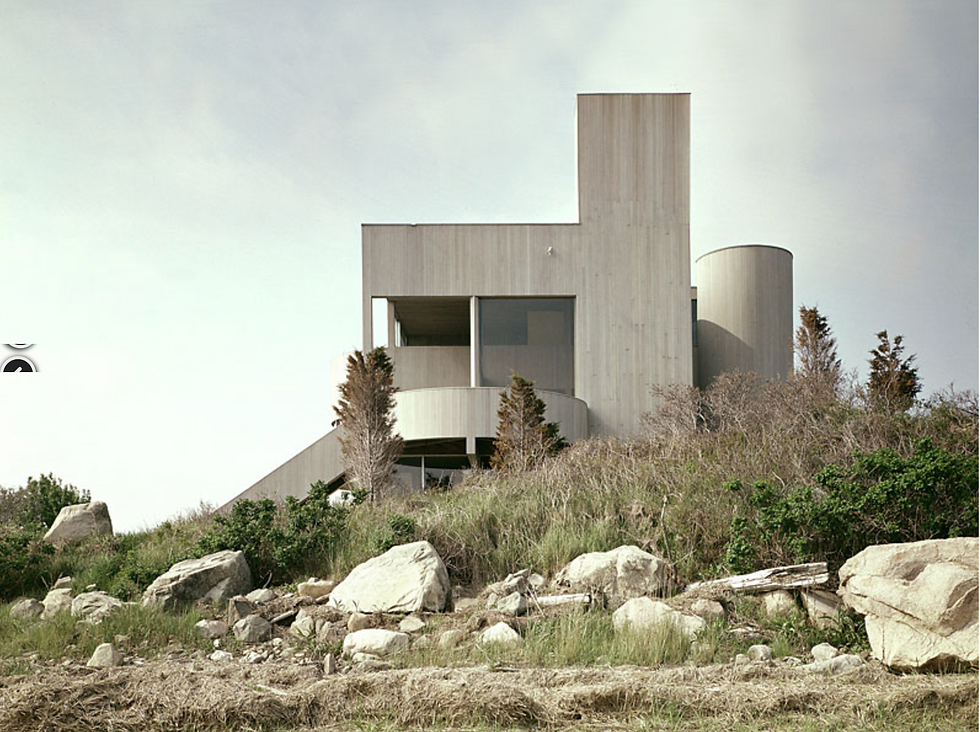


Cooper Residence by Charles Gwathmey Siegel

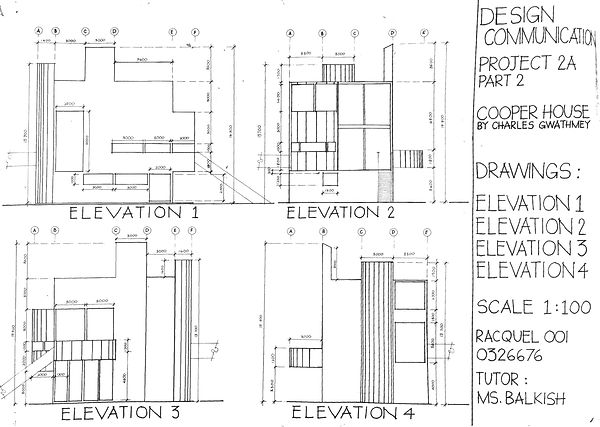

Project 2B: Axonometric Projection
Axonometric drawing is an excellent method of communicating and expressing an architectural idea – be it as a diagram at a fairly early stage of the design process (ie. conceptual expression) or as a presentation aid upon finalization of your design.
Axonometric drawings are a visually instigating and exciting way of expressing an idea clearly with minimal words if executed well.

Project 2C: Perspectives
This assessment introduces perspective as a mode of communication in architecture. It is required to construct firstly, one exterior (two-point) perspective followed by one sectional interior perspective (one- point).
In constructing both these perspectives, I am to demonstrate the ability to express spatial idea in 3-D form, understanding of 2-D and 3-D relationships in architectural graphics, skills in drawing and composition, creativity and complexity of drawing. Also, the selection of space and exterior form is significant

Project 3: Finishing & Presentation
As for Project 3, the module is combined with Architecture Design Studio I; hence the sketchings, orthographic drawings and perspectives are to be produced based on the design from the Architecture Design Studio I module.
To obtain a clearer understanding on the design concept of this model, please proceed here


