architecture culture & history I
Precedent Study & Analysis
The precedent study and analysis for architecture culture & history I comprises of three parts naming A, B and C.
In this section of the module, we were assigned to a historical building in its architectural period and hence these buildings are to be analysed thorougly in-depth.
Part A: Online Group Forum Discussion
Task assigned:
i. Who was the architect or founder of the building?
ii. What was the concept or philosophy of the architect or founder that makes the building historically significant / meaningful?
Coverage:
Architect / founder,
Concept / philosophy sketches, Architectural Style, Main architectural element, Significant characteristic.
Below is the task assigned to me; where I cover on the architect/ founder of the given building and the philosophical concept of the related building. The building given to us was the Church of Saint Yves at La Sapienza, in Rome, Italy.
If the following work is unable to be seen, please click here to be directed to the WiKi TiMeS forum.
BUILDING: CHURCH OF SAINT YVES AT LA SAPIENZA
1. i. Who was the architect or founder of the building?
Architect: Francesco Castelli (Borromini)
Founder: Pope Boniface VIII
Period: Baroque (late 16th century)
Construction Year: 1642-1660
Baroque architecture expresses the triumph of the Catholic church.
The church became a University in 1935 as founded by Pope Boniface VIII; as the church La Sapienza represents the house of knowledge.
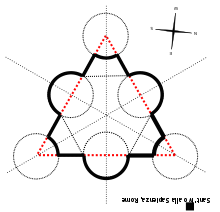
PLAN OF THE BUILDING
FRANCESCO BORROMINI
Architect: Francesco Borromini (1599-1667)
-
Principal of architects in the Roman baroque period
-
Boldest and most original architect during the Roman baroque period
-
His works were significant throughout Europe & South America
-
One of the architects who dominated Roman baroque architecture (first half of 17th century)
-
Portrayed the imaginative & distinctive side of baroque architecture
-
Most extravagant architect in history for the 18th & 19th century
-
Works aroused disagreement in Protestant Europe and America & being copied in Latin America, Germany, Austria, Spain & Portugal
-
Successful in career & made as a knight of Christ by the Pope in 1652
-
Permanently discouraged by Bernini's (also dominated Roman baroque architecture in 17th century) greater fame & restless quest for perfection
-
Started gaining independent commission in 1632 and fame was rapidly developed
Borromini's masterpiece during Roman baroque architecture is San Carlo all Quattro Fontane (church); dedicated to the freeing of Christian slaves
San Carlo all Quattro Fontane (church) 1634 - 1648
BORROMINI'S STYLE
-
Inspired by the highly personal art of Michelangelo
-
Personal style (inclusive of certain elements of the Gothic)
-
Adapt classical elements - organic curvy lines & geometrical forms
1. ii. What was the concept or philosophy of the architect or founder that makes the building historically significant/ meaningful?
BORROMINI AT SANT'IVO ALLA SAPIENZA
Borromini adapted to the existing palazzo, also incorporating several his own architectural concepts.
Sant'Ivo alla Sapienza (Church of Saint Yves at La Sapienza)
-
Masterpiece of Roman Baroque Church Architecture
-
Roman catholic church built to memorialise to Saint Yves
Saint Yves:
-
Patron saint of lawyers
-
Became a monk; fought against prejudiced taxation & helped the poor
INTERIOR FACADE
-
Walls are painted white
-
creates a grand atmosphere
-
gives an otherworldly airiness
-
pleases the eyes & the mind
-
-
Applying Borromini's style & concept
-
Consists of equilateral triangle
-
Points of triangles cut off & rounded into curves
-
The organic shapes and line curvatures applied in the interior façade portrays Borromini's passion for geometry
Borromini was forced to adapt his design into the existing palace.
EVOLUTION OF STAR OF DAVID
1. Star of David (a six-pointed figure consisting 2 interlaced equilateral triangles, used as a Jewish and Israeli symbol)
Two intertwined triangles:
-
one pointing up to God
-
one pointing down to man
The six points represent:
-
creation
-
revelation and redemption
-
along with God
-
Israel
-
Gentile world
2. Lines of curvatures
3. Combination of Star of David & curvatures
Curvature: concave & convex - adding interest and movement in the facade
EXTERIOR FACADE
SPIRE
Most remarkable spire of any church in Rome, Italy. It's resemblances are:
-
Corckscrew lantern (geometrical curves)
-
Cruxific (Christianity)
-
Bronze orb, laurel wreath, dome
-
Spiral staircase (to continue the upward thrust of the building)
-
“Sapienza” means “knowledge” or “wisdom” in Italian
The church associates with the institution of higher learning, that the upward momentum of the church connects wisdom and spiritual faith
-
-
Reminiscing the friezes on the nearby columns of Trajan & Marcus Aurelius.
Some speculate that Borromini based the design of Tower of Babel.
Tower of Babel (myth in the Hebrew Bible/ Old Testament)
-
Popes who have contributed funds were honoured by Borromini through the incorporation of their families' symbols on the structure.
PopePapacyFamily Symbol
Gregory XIII 1572-85BuoncampagniDragon
Pope Sixtus V1585-90MontaltoLion, pears, three mountains and star
Pope Paul V1605-21BorgheseDragon, eagle of
Pope Urban VIII1623-44Barberini Bees
Innocent X1644-55Pamphilij Dove, olive branch, three fleurs-de-lis
Alexander VII1655-67Chigi Six Mountains, Star, Acorn
REFERENCE LIST
Nemes (n.d.), retreived on 20 April 2016, http://www.sacred-destinations.com/italy/rome-sant-ivo
Encyclopaedia Britannica (2016), retrieved on 20 April 2016, http://global.britannica.com/topic/San-Carlo-alle-Quattro-Fontane
Got Questions Ministries (2016), retrieved on 20 April 2016, http://www.gotquestions.org/star-of-David.html
Blog.bg (n.d.), retrieved on 21 April 2016, http://apollon.blog.bg/izkustvo/2010/12/19/pritchata-za-vavilon-i-globalizaciiata.653372
A view on cities (2016), retrieved on 21April 2016 http://www.aviewoncities.com/img/rome/lveit0233s.jpg
Encyclopaedia on World Biography (2004), retrieved on 21 April 2016, http://www.encyclopedia.com/topic/Francesco_Borromini.aspx




Part B: Precedent Study & Analyses Journal and Comparative Analyses Report
In part B, the task assigned was to utilize the information gathered in Part A of the Online Discussion Forum and provide a precedent study and comprehensive comparative sketch analysis of the building. It is required to generate an in-depth precedent analysis (of: style, form, structure, floor layour, interior, exterior & façade elements, circulation, function, social impact) of the accounts listed below:;
Related illustrative Architectural Historical Timeline in chronology order that highlights and explains the significant aspects of the building in Architecture History.
-
With reference to the timeline, generates comparative analysis of the building with the before and after architectural style.
-
With reference to the timeline explain the technology development and advancement related to the architecture of the building
3 types of sketch analysis:
i. Architectural Historical Timeline sketches
ii. Comparative analysis with the before and after architectural style iii. Technology development and advancement


Part C: A2 Presentation Board
Task assigned: A2 Board Analysis should include:
-
Answers to the Precedent Study Analysis questions below:
-
How does the building reflect the spirit of the time and place for which it was built?
-
What are the initial ideas and the design concept?
-
How the initial ideas and the design concept affecting the architecture?
-
-
By conducting analysis of one of element selected from # 1 to 5 and to synthesize the design concept in Partí of # 6.
-
Illustration of Precedent Study Analysis in relation to the series of building conceptual elements listed below – (may consists of the following):
Analysis Sketches of:
-
Architect, Location Plan, Concept, Philosophies, Culture
-
Building-Context connections: Site Plan, Site Section,
-
3D Mass-Context Study. Spatial Layout: Building Plan, Elevation, Sections;
-
Social-spatial Experience /Subtractions Sketches/ Significant Architectural elements/concept: Geometric
–
-
3D Architecture Elements & Structures Study, Details Façade & Sections, 3D Details,
Qs 2. Building massing analysis
i. Material and Structure- geometry of making,
ii. Geometry -alignment/anthropometry/social geometry/ideal geometry
Qs 6. Partí - Culminates and Summarizes (i. gesture, ii. essence, iii, dominant idea, iv salient characteristic of the building

Reflection
The Architecture Culture & History I module has taught me about the history of many authentic buildings during the architectural historical period. I have learnt about the different types of elements that represent the different architectural period and this has made me easier to identify the culture and history of certain architectural buildings. This module has taught me that architecture does not only revolves around the modern days design; instead it helps broaden my knowledge on the architecture history on how art and architecture was once a conceptualized design along with religion and culture where they are all merged. It is no doubt a module that improves my understanding on the architectural culture & history, as well as my sketches of the historical buildings.
Besides, the assignment in this module required teammates to work together as a team as to enhance toleration and patience among each other. It is also a great platform for us students to exchange ideas about working on this module; hence the various perspectives and thoughts from the teammates allow us to widen our knowledge.