architecture design studio III


project one
Analysing Architecture – The Journey of the 5 Senses
project two
Genius Loci
Visitor Interpretive Centre
Spatial organisation is a key consideration for architects in architectural design. The study and exploration of different spatial organization methods is important in design because it informs human occupation, behavior, and experience within architectural spaces. Writers such as Francis D.K. Ching labeled this as architectural ‘order’ whilst Alexander Purves called this ‘the formal patterns’. This, is an introductory assignment by which we are required to analyse spatial typologies and poetics case studies.
PROJECT BRIEF
In groups of 5 students, one (1) precedents for analysis (refer to list on p. 3) is selected; consisting of local, national and/or international examples. The precedent study should provide the following analysis:
A. Function
-
Describe the function and design brief of the VIC
-
Explain how spaces are organised to achieve the brief
-
Explain how the entry and exit points are designed
-
Explain how the building functions as interpretive centre: what are the artefacts/interpretive material, and it has informed the architecture and space planning.
B. Spatial Typologies
-
State and describe the spatial typologies applied in the design
-
Explain how the spaces are organised and ordered (cross-reference to 1 (ii)
See Francis D.K. Ching’s Form, Space & Order & Purves’ Formal Patterns
C. Spatial Poetics
-
What is the design considerations employed to explore spatial poetry/poetics/experiences?
-
How are the spaces articulated in terms of the poetics, sensuality and tactility of architectural spaces?
-
Flow of experience (identify key circulation/journey).
-
Using at least 5 images/perspective that illustrate poetics of space, analyse how the experiential space is created: Engagement with senses; Manipulation of light and its effects on space (natural & artificial); Texture and materiality; Scale and proportion of spaces etc.
See Steven Holl’s Questions of Perception: The Phenomenology of Space & Juhani Pallasmaa’s The Eyes of the Skin
D. Plan - Section Relationship
-
Co-relate the plan to one of the most interesting section of your selected building. Study the section and analyse how it is designed. Produce Re-draw the section to demonstrate your understanding of materiality, structure, tectonic logic, scale & proportion, spatial qualities of the project
See Paul Lewis, Marc Tsurumaki, and David J. Lewis’ Manual of Section
CASE STUDY
Kemenes Volcano Park Visitor Interpretive Centre
by Foldes Architects


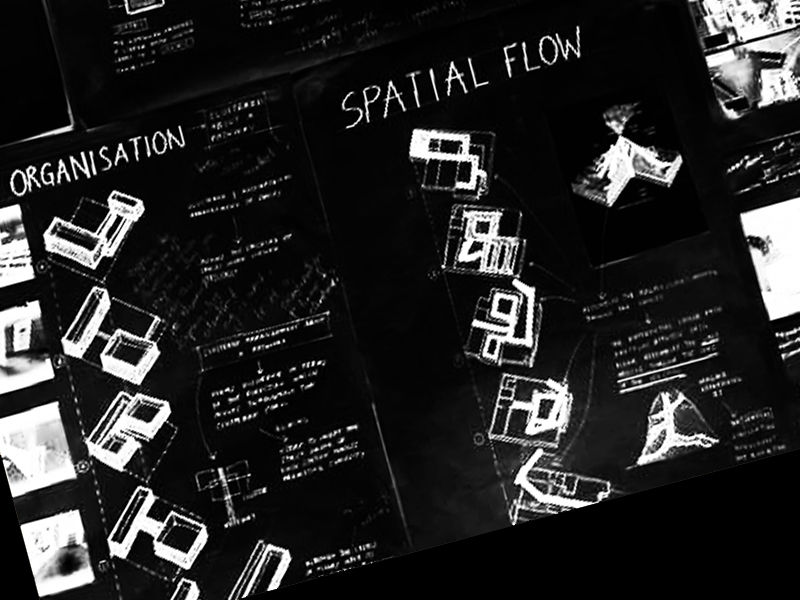


PROJECT BRIEF
Sketch Design
Objective:
To propose a design scheme which response to the site (site topography, history and socio-cultural events), functional program and users’ experiences
1. Select and/or consolidate initial design concept / ideas and develop it by producing a schematic plan and section, and a study model 1:250. The schematic should respond to the physical site context and functional requirements.
2. Consider and develop the primary circulation of the visitor through your architecture (the route). Produce spatial model(s) at the scale of 1:250 to illustrate your ideas. (At this point, you should be able to develop your design work by integrating thermal comfort considerations for Building Science I)
KEY SECTION AND EXPERIENTIAL SPACES
Objective: Generate design through conscious consideration of human scale, natural light, materials/texture (User experience).
1. Consider the flow of experience: flow of space, intermediate/transition spaces, the variation and hierarchy of spaces, inside/outside relationship, manipulation of light, texture & materiality and scale & proportion. Produce thumbnail sketches/models to illustrate your ideas.
2. Develop your design through the sectional drawing of your architecture. Produce 1 key section 1:50.
3. Produce one key interior perspective to illustrate the experiential spaces of your architecture. Visitors should be inspired and informed in ways that somehow express the spirit of place.


