project three


project one

project two


Weekend Getaway
On my own, I am to further develop my project 2 into a Weekend Getaway at National Botanical Garden. A Weekend Getaway denotes ‘A place where one escapes for relaxation, recreation and vacation for a short period of time.’
This Weekend Getaway must function as habitable architectural spaces to enable the activity associated with living, dining, showering, cooking, storage and such within the built up space of 150 m2.
The relationship between the design and the context is also important in making the Weekend Getaway unique to its landscape and activity.
Objectives of project are:
• To introduce the notions of concepts, program and process in architectural design
• To introduce students’ to the understanding of user specific design requirements
• To introduce the notions of space, form and function in architectural design
• To introduce awareness of site specific design and the process of site analysis
1. Interpret and analyse simple site context
2. Interpret and analyse client’s character and needs in relation to the design of a small building
3. Design a simple building type that meets user requirements and respect site context that balances both internal (architectural spaces/layout/circulation) and external (aesthetics and forms) design values
retreat house
n a r r a t i v e . . .
This proposal derives its idea whilst hiking up the hill of Bukit Saputangan, Botanical Garden, Shah Alam. Whilst I was resting to take a breather, it has come to my mind regarding the fascinating natural atmosphere as I looked up the sky.
It has prompt me on the sights of the upper region of the hill, where the growth of leaves and its silhouette formed by way of its attachment to the tree branches. It can be perceived that the natural growth of the tree branches embody the bold spirit of movement that extends extensively and intervine in an angular manner. Thus, the attachment of the leaves to the tree branches permeates light to penetrate to the inner part of the hill. And when light penetrates, it further casts shades. Hence, it brings about the emergence of light and shades.
In continuation of concept, the space composition in my retreat house is articulated in an angular manner, in expressing the appreciation of nature in its bold spirit and movement.
Contextualism - the retreat house incorporates two featuring elements at the same time; where attention is brought to duality in unison; which is to conform, and to contrast. As to conform to the topography, the the composition of spaces is defined with slight change in levels. As the contour of the topography slopes downwards, the level changes to being lowered - to harmonise and conform to the topography. Apart from the change in levels, the retreat house is also embedded in the contour; to portray the building as being part of the natural environment. As to contrast, among the other spaces, the 'observatory' in the retreat house is expressed with verticality, to appear distinguishable for the people.
In the retreat house, each space is defined by its structure and the character of its natural light. The entrance is intended to be dark - to create a spirit of enquiry as accessing into the retreat home. Hence the space is composed with just enough amount of light with some openings, to tell how dark it really is. As with the emergence of light and shades, the cast of shades in the entrance is a form giver for silent spaces. Hence, the intention is to bring attention to continuing the uninterrupted sequence of spaces into the retreat house.
As the sequence of spaces progress, the spatial experience is enhanced with a contrast of brightness (as expressed with openings to a greater extent) to provide opportunity for the appreciation of nature; as well as to bring about the association of man and environment. The open-space area (beginning from the central courtyard, living lounge, bedroom space) further amplifies on the interaction between people, as to present a pleasant counterpoint to the today's lifestyle - where people are occupied with themselves.
'Light which has been spent, and this crumpled mass called material casts a shadow, and the shadow belongs to Light' - Louis Kahn
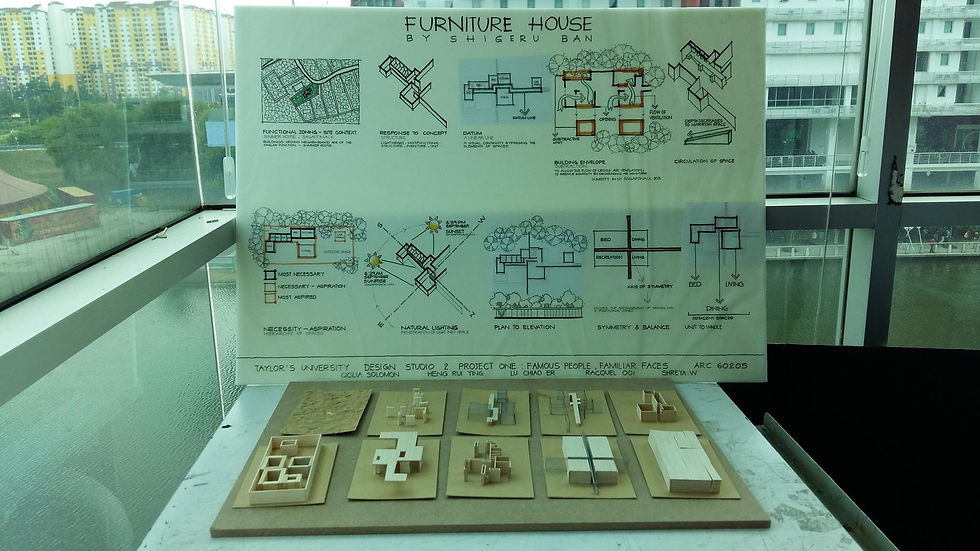
Famous people, familiar faces - Diagrammatic Abstraction
To investigate and to explore how spaces are created from the making of architectural elements: architectonics - solid, planes, lines and frames. Upon completion of the project student should be able to achieve a level of understanding on the works assigned and will be able to apply the idea and concept to their project later. The idea of using pure and diagrammatic models to express the architectural idea would also be in cooperated into this assignment. 1. Ability to identify master architects and their works 2. Understanding basic architectural compositions of solids, planes, lines and frames. 3. Ability to ‘diagram’ and analyse architectural work of selected architect.
Selected architect and house; Shigeru Ban - Furniture House


Introduction to Site Analysis + Pavilion @ National Botanical Garden Shah Alam
1. Introduction to Site Analysis (Group Work)
I was required to conduct site analysis of the physical context both at a macro & micro level of the overall site.
The following references were used as a framework for your recording and analysis of your site:
White, E. 2004. Site Analysis: Diagramming Information for Architectural Design. Tallahassee, Florida: Architectural Media Ltd.
Collect data and record on the following using physical maps/diagrams: § Site plan (Site section, Site Boundaries, North Point, Contours) § Existing Structure (Significant Architectural Language/Feature, Adjacent building/structure building to remain/demolish) § Landscape (Natural features, Soil Condition, Surface Drainage, Existing vegetation) § Climatic Studies (Sun path, wind direction, rain) § Circulation pattern (pedestrian, vehicular) § Views and Vistas (Panoramic /spot in, out, approaching) § Activities (category -dry/wet, zoning, noise) § Case Studies (Perdana Canopy & The Bamboo Playhouse ) You are also required to do a site model of the respective site(s) 2. Pavilion @ National Botanical Garden, Shah Alam § In group of 2, you are to design a pavilion (with a maximum volume of 30m3) for the purpose of relaxation and pleasure. It shall include other activity(s) such as meditation, observation, etc. in which furniture and equipment must fit and be incorporated into the design. This structure should correspond to the site that you have chosen. Adequate access, circulation and fenestration are mandatory
Partnership: Racquel Ooi Yi Lynn & Shum Li Sze
a r c h i t e c t u r e d e s i g n s t u d i o I I


